
Understanding in the Moment Cards: Why They Matter and How to Use Them

Public moments can become heavy without warning. A grocery store aisle, a busy sidewalk, a waiting room — places meant to be ordinary can quickly turn overwhelming for individuals with autism or other special needs, and for the parents and caregivers supporting them.
In those moments, caregivers are often holding far more than what’s visible. They are supporting regulation, ensuring safety, preserving dignity, and managing the emotional weight of being watched, judged, or misunderstood — all at once.
Understanding in the Moment Cards were created to ease that burden.
What These Cards Are — and Why They’re Different
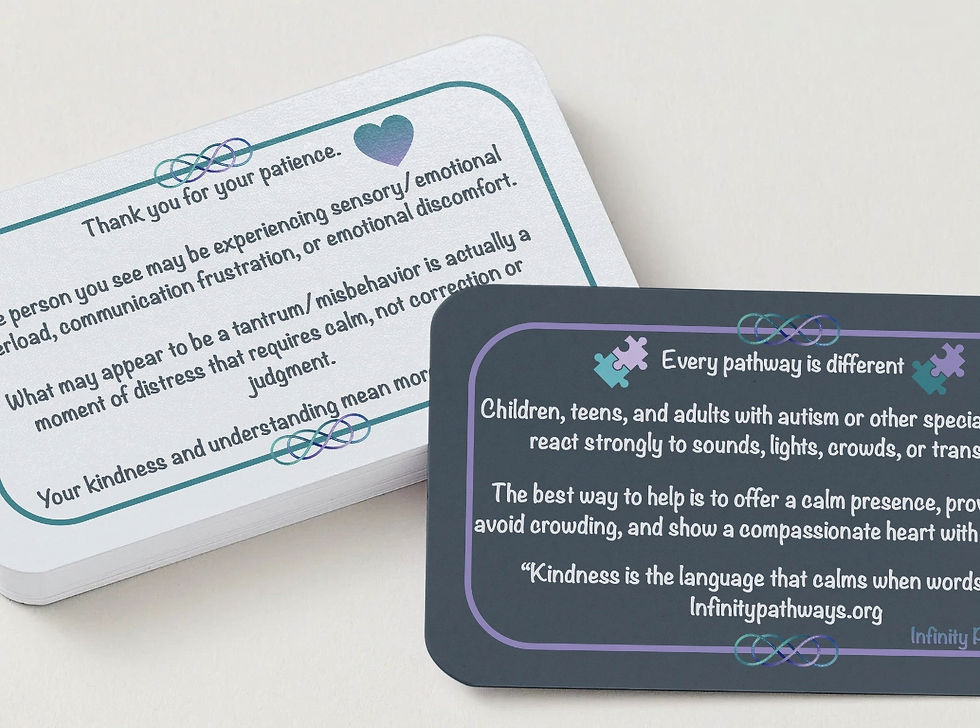
Understanding in the Moment Cards are not behavior tools, nor are they explanations directed at the individual. They are quiet, compassionate communication tools for the people around you.
Each card offers a short, respectful message designed to gently educate bystanders during moments of visible distress. The language centers on patience, space, and understanding — reminding others that what they may be witnessing is not misbehavior, but a moment that requires calm rather than correction or judgment.
The cards help caregivers communicate without:
Explaining medical details
Answering intrusive questions
Justifying their child or loved one
Sacrificing privacy or dignity
They say what needs to be said — so you don’t have to.
Why Understanding in the Moment Cards Matter
1. They Protect Dignity
When a child, teen, or adult is overwhelmed, the last thing they need is to become the focus of public scrutiny. These cards redirect attention away from judgment and toward compassion, preserving the individual’s dignity in vulnerable moments.
2. They Shift the Narrative
The messaging reframes what others may assume is a “tantrum” or “misbehavior” into what it truly is: sensory overload, communication frustration, or emotional distress. This simple shift can dramatically change how a situation is received and handled.
3. They Offer Gentle Education
Without confrontation or discomfort, the cards educate others on how best to help — offering reminders to give space, avoid crowding, and lead with kindness.
4. They Support Caregivers in the Moment
Caregivers shouldn’t have to carry emotional labor on top of everything else. These cards provide reassurance and backup when words are hard to find or energy is already depleted.
5. They Create Small Moments of Change
Even one interaction rooted in understanding can ripple outward. These cards quietly advocate for inclusion, patience, and empathy — one moment at a time.
How to Use Understanding in the Moment Cards
Keep Them Close
The cards are designed to be compact and discreet, fitting easily into wallets, purses, sensory bags, or pockets so they’re available exactly when needed.
Use Them Selectively
You can hand a card directly to a bystander, place it somewhere visible, or briefly show it without further conversation. There’s no requirement to engage beyond what feels safe and manageable.
Let the Card Speak for You
The wording has been thoughtfully chosen to communicate calmly, respectfully, and clearly. You don’t need to add anything unless you want to.
Use Them Anywhere
These cards are helpful in stores, on public transportation, at events, in medical offices, in schools, and in community spaces — anywhere a misunderstanding can quickly escalate tension.
Who These Cards Are For
Understanding in the Moment Cards are designed for:
Parents and caregivers
Teachers and educational staff
Community workers and support professionals
Anyone supporting individuals with autism or other special needs
They are for those moments when compassion matters most — and when having the right words can change everything.
Created With Purpose
At Infinity Pathways, every resource is created with lived experience at its core. These cards exist because families deserve support that is practical, respectful, and rooted in empathy — especially in the moments no one prepares you for.
Empowering caregivers. Protecting dignity. Inspiring compassion — one moment at a time.


Comments